Upper School teachers Jason Straub and Dick Ohern along with student Laura Brown traveled to New York City on Sept 21 for the People's Climate March. The New York event was one of nearly 3000 coordinated events in 162 countries. The gathering was also meant to support the historic meeting of over 100 dignitaries from around the globe all working toward the prevention of global warming.
Sunday, October 19, 2014
Climate Change Activism Alive in the Upper School
Sunday, October 12, 2014
Out and About with the LS Outdoor Explorers
Seventeen 4th and 5th grade students, all members of the Lower School Outdoor Explorers Club, under the direction of teachers Craig Newberger and Peter Waxler recently headed to Fort Washington State Park and the Wissahickon Gorge for outdoor adventures. Dedicated to exploring a variety of natural
communities including forests, fields, streams, ponds, and wetlands the Outdoor Explorers events during the autumn season will focus on observing wildlife ( including mammals, birds, reptiles, amphibians,
fish, and insects ) in nature areas that include The Preserve at GA, Briar Bush Nature Center, the
Wissahickon Valley Watershed Association, Gwynedd Wildlife Preserve,
Peace Valley Nature Center, and the Wissahickon Gorge.
Sunday, October 5, 2014
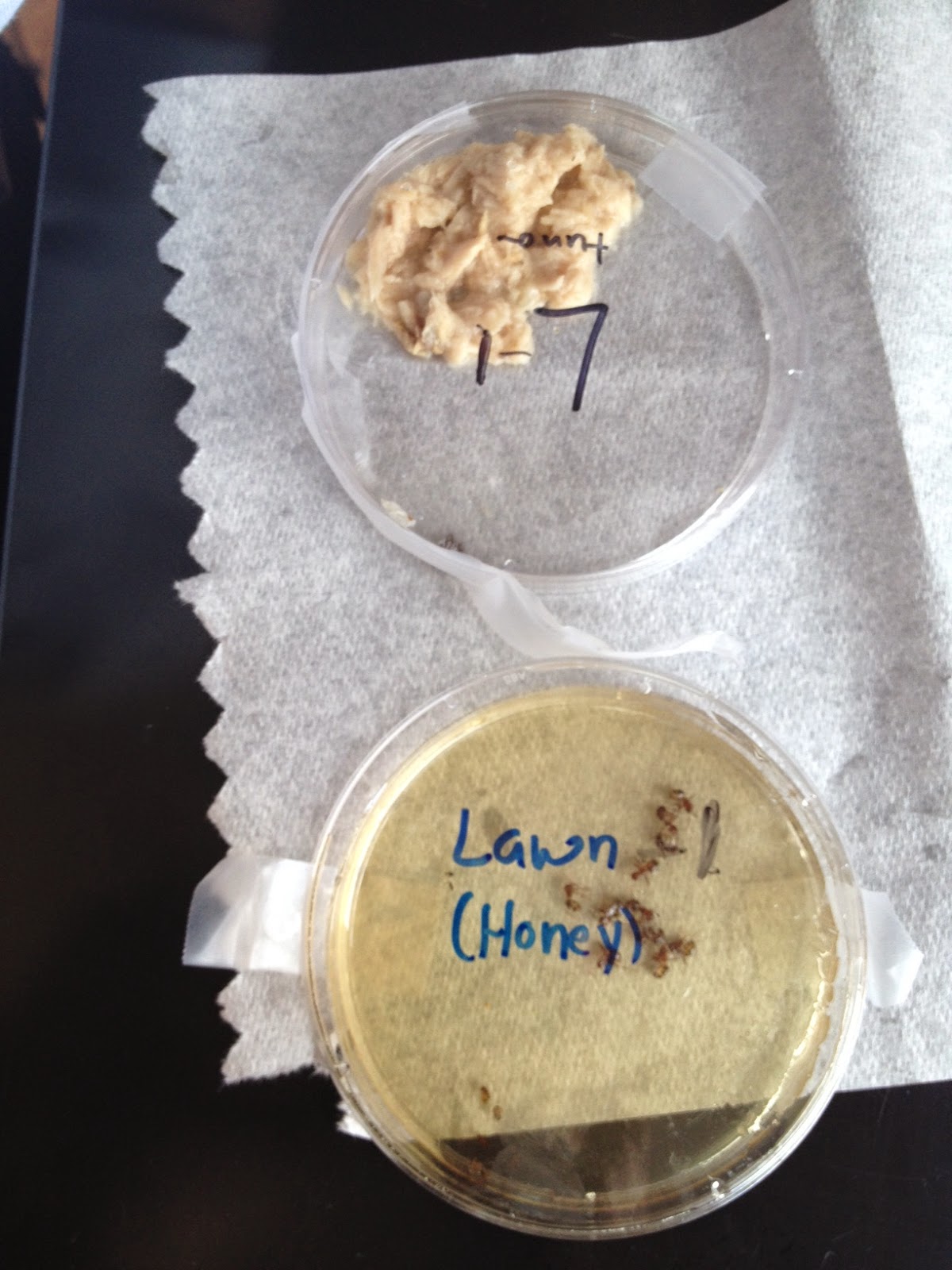
The Impact of Human Disturbance on Biodiversity Study
Early in the year and when the weather is still more summer than fall, the students in Dick Ohern's AP Environmental Science class heads to the wetlands. In a lab called, "The Impact of Human Disturbance on
Biodiversity" students set baits (oily tuna and honey as
some ants like fats and some like sugars) in
different environments on campus. Ohern reports, "We then collect them perform ing calculations that give us measures of relative
biodiversity in the groupings of ants collected. We sample in the woods
near to the creek, in the tall grasses of the preserve,
on a piece of lawn (this year in the Academic Courtyard), and on the
stadium turf. Prior to doing the activity, the kids have to hypothesize
about the relationship between human disturbance and biodiversity, and
the data they collect allows them to then reflect
on that hypothesis after the data is analyzed." He continued, "This lab makes use of environments on campus that the kids can
relate to. They understand that the woods and the preserve are
relatively more natural areas than the lawn and the totally artificial
stadium turf. The preserve is interesting in that it
is newly "constructed" and we don’t yet see many ants there, though the
kids ( and I) think we ought to. My guess is the poor, clay soils there are hindering colonization by ants, but of course it may be
more complicated than that." Students love being able to use the campus outdoors spaces as extensions of their science labs.
In APES, as in other science classes, a good number of the lab activities happen outdoors, mimicking on a small
scale what real ecologists work.
Sunday, September 28, 2014
Design Thinking Recess in the MS
Monday, September 22, 2014
Snapping Turtle Nest in the Preserve
Tom Plasket and Bill Cooper, of GAs Physical Plant, were in the Preserve at the start of the school year working on some of the signage in the area, when they saw the ground move! They had uncovered a snapping turtle habitat able to flourish in the area of the Preserve. Snapping turtles travel up to a mile away from the water to find a soft nesting place. When the young are born, their instincts lead them back to the water. Plasket and Cooper found these little guys, only a few hundred feet from the swale built last year to redirect water in the Preserve. Lower School science teacher Lisa Martin commented, "It's not surprising. They are almost entirely aquatic and love slow-moving water with a soft muddy bottom. So our pond in the Preserve is perfect. And the Preserve is teaming with their favorite foods: plants, insects, spiders, worms, fish, frogs."
Sunday, September 14, 2014
5th Grade Salamander Study
Fifth grade students, sporting their wellies and water shoes headed to the Wissahickon creek last week to begin their salamander study led by their teacher Craig Newberger who has been teaching science in GA's abundant outdoor spaces since he arrived here over 25 years ago. A pathfinder in outdoor and hands on science education Newberger's programs have been the gold standard for an integrated science curriculum incorporating classroom and site studies, modeling for area schools and colleagues best practices for the study of environmental science. "He makes science fun." commented one student above the squeals from others as they entered the chilly water noting, "This is the best class, ever!"
Saturday, September 6, 2014
The Gift That Keeps on Giving
Senior Pat Longo and his Eagle Scout troop worked tirelessly to help restore the Ballay Garden along the Wissahickon. The meditation garden was a gift to the GA community community from the Ballay family in memory of their son Cole. Since it's installation in 2009, storms and flood waters have disrupted the hardscaping around the seating area and entrance way to the creekside garden. When Longo approached Upper School Nature Program Coordinator and Preserve manager Sarah Kesten to inquire about a school need the garden was on the top of her list. The decision to restore the garden was an easy one for Longo who loves the outdoors and felt that this particular project was a great way to honor a fine young man and give back to GA.
Subscribe to:
Posts (Atom)